
CHAPTER 01
Project Overview
1.1Introducing pXToken
As demand for artificial intelligence, large-model training, high-performance rendering, and distributed computing continues to expand, the global digital economy is entering a new phase in which compute is the core resource. Compute resources made up of GPUs, CPUs, and edge devices have gradually become essential infrastructure for the AI industry, smart manufacturing, scientific simulation, and digital finance. At the same time, vast amounts of compute remain scattered across regions and devices worldwide, unable to be unified under shared scheduling and coordination — leaving them idle for long periods and wasting efficiency.
Traditional centralized cloud platforms have addressed enterprise-grade compute demand to a degree, but their operating model depends on large data centers and closed resource management systems. Platform control is highly concentrated, compute costs keep rising, and small-to-medium developers and ordinary users can hardly take part in the global compute economy. Opaque allocation of compute resources, uneven node revenue, and excessive platform fees are further constraining the development of AI and distributed computing.
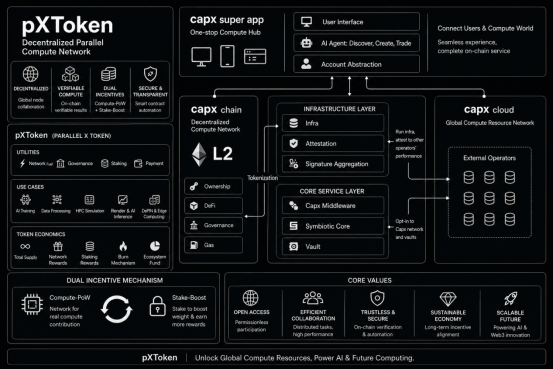
pXToken (Parallel X Token) is a decentralized parallel compute network born against this backdrop. Initiated by the Parallel X Foundation, the project is committed to building an open, transparent, and incentivized global parallel compute infrastructure through blockchain technology, distributed node collaboration, and verifiable compute models. By connecting GPUs, CPUs, and edge devices worldwide, the network turns previously isolated compute resources into on-chain digital compute assets that can be scheduled, verified, and circulated.
The Parallel X network does not rely on a single server or centralized data center. Instead, it adopts a distributed node collaboration mechanism in which nodes across regions and performance tiers jointly execute tasks. AI training, data processing, and high-performance computing tasks are split into multiple verifiable compute units, distributed to different nodes through the on-chain scheduling system, and finally validated and rewarded through a unified verification mechanism.
To keep the network stable over the long term, pXToken introduces the dual Compute-PoW and Stake-Boost incentive system. Nodes earn rewards not only for real compute contribution, but also for staking, which increases their task acceptance weight and verification revenue — forming a long-term cycle of contribution, incentive, and collaboration. The entire reward process executes automatically through on-chain smart contracts, eliminating human intervention and privileged control.
pXToken's goal is not merely to build a compute rental platform, but a genuine global parallel compute network. In the coming AI era, compute will gradually become a foundational resource on par with energy and data, and the Parallel X network aims — through decentralization — to let any individual or institution in the world participate in the compute economy, enabling open sharing and value reconstruction of compute resources.
1.2Defining the Parallel X Network
Parallel X is a decentralized parallel compute network built on blockchain. Its core goal is to connect scattered GPUs, CPUs, and edge devices worldwide into a unified, collaborative computing system that achieves efficient utilization and value sharing of compute resources through on-chain scheduling and verifiable execution.
In traditional internet architecture, compute resources are controlled by a small number of large platforms and cloud providers. Large numbers of small and mid-sized devices have real compute capacity yet struggle to enter the global compute market. Meanwhile, demand from AI model training, high-performance rendering, scientific simulation, and real-time data analytics keeps growing, and the traditional model can no longer satisfy the digital economy's need for elastic compute.
Through its decentralized node mechanism, the Parallel X network brings these previously scattered compute resources into one network. Every node can participate in task collaboration at different levels according to its hardware capabilities, with an on-chain record forming a traceable, verifiable contribution system. The system automatically assesses each node's hardware performance, online status, historical reputation, and task stability, and dynamically assigns suitable compute tasks.
The entire network is designed around a parallel compute architecture. Complex tasks are split on-chain into multiple independent compute segments; different nodes execute different parts of the task simultaneously, and the verification layer aggregates the results. This model not only improves overall compute efficiency, but also effectively reduces single-point-of-failure risk, giving the network greater scalability and resilience.
To ensure the authenticity and security of task execution, Parallel X introduces a verifiable compute mechanism. After completing a task, a node must pass multi-node cross-verification and on-chain result confirmation before receiving the corresponding reward. Any abnormal behavior, false computation, or malicious submission triggers reputation deductions and staking penalties, maintaining a fair operating environment across the network.
The Parallel X network serves not only AI model training, but also scientific research, industrial simulation, 3D rendering, data analytics, edge intelligence, and more. As global digitization accelerates, more and more industries depend on high-performance compute, and the open compute network Parallel X is building will gradually become critical infrastructure connecting the world's digital resources.
pXToken is the core value carrier of the entire ecosystem. The token not only powers node incentives and task settlement, but also serves as a key medium for network governance, resource scheduling, and ecosystem collaboration. All node contributions, task execution, and revenue distribution are recorded and settled on-chain, forming a truly transparent, trustworthy, and sustainable decentralized compute network.
1.3Vision and Mission
The development of artificial intelligence is pushing the world into a new stage of digital civilization. Large AI models, automated decision systems, intelligent robots, and multimodal applications are constantly changing how human society operates — and the core resource behind all of these technologies is ever-growing compute capacity.
Although the world's compute resources are vast, they remain highly fragmented. Large numbers of GPUs and edge devices sit idle for long periods, unable to coordinate as a whole, while high-performance compute is controlled by a handful of centralized platforms, making it hard for SMEs and ordinary developers to obtain stable compute at low cost. This imbalance in resource allocation is becoming a key factor limiting the further development of the AI industry.
Parallel X aims to change this.
pXToken's vision is to build a truly open global parallel compute network, where any individual, institution, or device with compute resources can participate on equal footing in the global compute collaboration system. The network no longer depends on a single platform or centralized server; instead, a decentralized protocol connects nodes worldwide, enabling the free flow of compute resources and the sharing of value.
What Parallel X is building is not a simple compute platform, but an important component of future AI infrastructure. Through blockchain technology and distributed collaboration mechanisms, the project aims to transform the closed compute systems of the traditional internet era into an open, transparent, and verifiable global compute network.
In this system, compute contribution is digitized, assetized, and brought on-chain. Every task execution, every data verification, and every node collaboration forms a traceable contribution record and is fairly incentivized through pXToken. This means any device in the world may become part of the AI network, and every participant can share in the value created by the growth of the digital economy.
The mission of Parallel X is to drive global compute equality.
The project aims to lower the barrier to participating in high-performance computing, giving more ordinary users, small and mid-sized developers, and edge devices the opportunity to join the AI compute network. At the same time, the network provides enterprises and research institutions with lower-cost, more elastic, and more open distributed compute services, raising the overall utilization of global compute resources.
As the network continues to expand, Parallel X will gradually form a node collaboration ecosystem covering the globe. Compute resources across countries, regions, and device types will interconnect through a unified protocol. In the future, Parallel X hopes to become one of the essential infrastructures of the AI era, enabling truly open collaboration and free sharing of the world's compute resources.
1.4Core Value and Use Cases
Against the backdrop of rapid progress in AI and high-performance computing, compute has gradually become a key production resource driving the digital economy. Large-model training, automated inference, image rendering, industrial simulation, and real-time data analytics all require continuous, stable compute capacity as their foundation. At the same time, a large share of the world's compute resources remains scattered, devices lack a unified coordination mechanism, and resource utilization stays persistently low.
The core value of pXToken lies in using a decentralized parallel compute network to reorganize the world's idle compute into a unified system that is collaborative, verifiable, and incentivized. The Parallel X network does not depend on a single server or centralized data center; instead, a blockchain protocol connects compute nodes across regions, performance tiers, and device types, allowing previously isolated GPUs, CPUs, and edge devices to jointly take part in global compute tasks.
This model not only improves overall compute utilization, but also changes the highly centralized way traditional compute resources operate. Any user with device resources can join the Parallel X network, participate in task collaboration, and earn rewards based on actual contribution. Compute no longer belongs only to large platforms — it is gradually evolving into an openly shared global resource.
In the Parallel X network, all tasks are distributed automatically through the on-chain scheduling system. AI training, rendering, and scientific computing tasks are split into multiple verifiable compute segments and executed simultaneously by different nodes. The system dynamically matches suitable tasks based on node performance, online stability, and historical contribution, forming a more efficient parallel collaboration structure.
Large AI model training is one of Parallel X's most important use cases. As model parameter counts keep growing, training costs are rising rapidly. Traditional centralized GPU clusters are extremely expensive to deploy and suffer from resource concentration and scaling difficulties. Through distributed node collaboration, Parallel X can split training tasks across nodes worldwide for synchronized execution, reducing overall training cost and improving task scalability.
Beyond AI training, the network is equally suited to video rendering, industrial simulation, scientific research, and edge intelligence. Film rendering typically requires large numbers of GPUs running for extended periods, and the Parallel X network can distribute rendering tasks across nodes through dynamic scheduling, improving overall processing efficiency. Scientific simulation and data analytics scenarios likewise require high-performance parallel compute, and the network can provide research institutions with more open access to compute resources.
As the number of IoT and edge devices keeps growing, edge intelligence will become an important direction. Individual edge devices may have limited standalone compute, but under a unified coordination mechanism they can still form a massive distributed compute network. Through its open protocol, Parallel X hopes to bring more edge nodes into the AI network and drive further expansion of global compute resources.
pXToken is not just an incentive tool within the network — it is a key value medium for the operation of the entire ecosystem. Node incentives, task settlement, resource leasing, and governance voting all revolve around the token, forming a complete ecological cycle. As the network grows, the token's value will become ever more deeply bound to real compute demand.
1.5Positioning as a Global Compute Network
The global digital economy is gradually moving from the "internet era" toward the "era of intelligent computing." Data, algorithms, and compute have become foundational resources driving industrial upgrades, and the importance of compute is approaching that of traditional energy systems. The future development of AI model training, autonomous driving, smart manufacturing, digital finance, and metaverse applications will all depend on vast compute capacity.
The global compute market is currently dominated by a small number of large cloud platforms. While centralized platforms have advantages in resource integration and commercial operations, high usage costs, opaque resource allocation, and platform monopoly issues are becoming increasingly apparent. Meanwhile, large numbers of small and mid-sized GPU devices, edge nodes, and personal compute resources sit idle for long periods, unable to effectively enter the global compute market.
Parallel X is positioned not as a traditional cloud computing provider, but as a decentralized parallel compute infrastructure network for the coming AI era. Through open protocols and on-chain collaboration mechanisms, the project aims to build a globally shareable, verifiable, and schedulable distributed compute system.
The core logic of the Parallel X network is the unified coordination and standardized onboarding of global compute resources. Nodes across countries, devices, and performance tiers can all participate in task execution and value distribution under a unified protocol. This means compute resources are no longer confined to centralized data centers — they can flow freely across the globe, just as the internet connects information.
Compared with traditional platforms, Parallel X places greater emphasis on openness and collaboration. Any user can become a network node, and any enterprise or developer can call on distributed compute resources through the network. The network does not depend on a single operating entity; instead, it runs automatically through on-chain rules and smart contracts, reducing human intervention and centralization risk.
In its future development, Parallel X will not be limited to the GPU compute market. As AI and edge intelligence continue to expand, the network will gradually onboard more edge devices, lightweight nodes, and mobile terminals, allowing a broader range of device resources to participate in global compute collaboration. This model will further increase the network's scale and overall compute elasticity.
Parallel X also aims to become an important bridge connecting AI, blockchain, and distributed computing. AI provides the demand for intelligence, blockchain provides trusted collaboration mechanisms, and distributed computing provides actual execution capacity. Combined, the three form a new digital infrastructure system — and pXToken is the value core of that system.
As the global AI industry continues to expand, compute demand will keep growing at high speed. Through decentralization, Parallel X hopes to build a truly open, fair, and efficient global compute network, enabling more individuals and institutions to participate in building the core infrastructure of the future digital economy.
CHAPTER 02
Industry Background and Market Opportunity
2.1Growing Demand for AI and High-Performance Compute
Artificial intelligence is driving global industry into a new stage of development. As deep learning, large models, multimodal systems, and automated intelligence mature, AI has moved from laboratory research into commercial application, rapidly penetrating finance, healthcare, education, industrial manufacturing, intelligent transportation, digital content, and many other fields. More and more enterprises rely on AI to raise productivity — and all of it rests on ever-growing demand for high-performance compute.
Over the past few years, the scale of AI models worldwide has grown exponentially. The parameter counts, training data volumes, and inference complexity required for large-model training keep increasing; training a single model can require thousands of GPUs running for extended periods. The stronger the model, the greater its demand for compute. Compute is no longer a supporting resource for technology companies — it is gradually becoming a core asset that determines AI competitiveness.
The value of GPUs has risen accordingly. Compared with traditional CPUs, GPUs are far more efficient at parallel computation, making them better suited to AI training, image recognition, video generation, and complex matrix operations. Large numbers of AI companies and research institutions are continuously expanding GPU clusters to meet growing training demand. At the same time, high-performance GPU prices keep climbing, some popular models remain in chronic short supply, and the global compute market is showing clear signs of resource strain.
Beyond AI training, demand for high-performance compute comes from many industries. Film rendering requires long-running GPU computation; industrial simulation depends on complex physics calculations; biomedicine is accelerating drug discovery through AI and molecular simulation; and finance increasingly relies on real-time data analytics and intelligent quantitative models. All of these scenarios continue to push global compute demand upward.
Yet the growth of compute supply struggles to fully match market demand. Large data centers take a long time to build and require enormous hardware investment, while also facing energy consumption, equipment maintenance, and resource scheduling challenges. Although the traditional centralized model can provide stable service, its ability to scale is under growing pressure.
On the other hand, a large amount of compute worldwide remains underutilized. Personal GPUs, edge devices, small and mid-sized servers, and idle compute nodes are widely distributed across regions, but without a unified scheduling system these resources can hardly coordinate at scale. Vast amounts of potential compute cannot enter the market, further aggravating the shortage of high-performance compute.
The AI era's demand for compute is not a short-term phenomenon but a long-term trend. As generative AI, intelligent robotics, autonomous driving, and edge intelligence develop further, global reliance on high-performance computing will only deepen. The importance of compute resources will gradually approach that of energy in the traditional industrial era.
Against this backdrop, how to improve global compute utilization, lower the cost of high-performance computing, and build a more open and scalable compute network is becoming a key focus for the entire industry. The decentralized parallel compute network Parallel X is building is precisely a new kind of solution proposed in response to this long-term trend.
2.2Problems with Traditional Centralized Compute Platforms
As demand for AI and high-performance computing grows, traditional centralized cloud platforms have gradually become the world's primary compute providers. Large technology companies build hyperscale data centers to offer GPU rental, model training, and data processing services to enterprises and developers. This model effectively drove the expansion of the digital industry during the internet era, but with the full arrival of the AI era, its limitations are becoming increasingly obvious.
Highly concentrated resources are one of the core problems of today's centralized compute platforms. Most of the world's high-performance GPU clusters are held by a handful of large institutions, and the market shows a clear trend toward monopoly. Small and mid-sized developers and ordinary users often struggle to obtain stable compute at low cost, and many AI innovation projects are forced to slow down because compute is too expensive.
At the same time, centralized platforms hold absolute control over resources. Task scheduling, pricing, resource allocation, and revenue rules are all decided unilaterally by the platform, and users lack a transparent participation mechanism. Although compute is critical infrastructure for the global digital economy, its operating logic remains built on closed systems — a model that is restricting the free flow of compute resources worldwide.
Continuously rising compute costs are becoming a universal industry problem. High-performance GPU prices keep climbing, and cloud rental fees remain high over the long term. AI model training often requires occupying large amounts of GPU resources for extended periods, and some mid-to-large training tasks can consume budgets of millions of dollars. For startups and SMEs, high cost has become a major barrier to entering the AI industry.
Traditional centralized platforms also suffer from obvious resource waste. Many data centers sit idle during off-peak periods, while scattered GPUs and edge devices worldwide cannot effectively participate in task collaboration. This means compute is scarce in some regions while other resources remain idle for long periods — the market as a whole lacks unified scheduling and dynamic coordination.
Single-point risk is another important hidden danger of centralized structures. With tasks and resources concentrated in a few large platforms, server failures, network outages, or policy changes can affect the entire compute service system. Multiple global cloud outages in recent years have already exposed the stability and resilience problems of centralized architectures.
Insufficient data transparency is also a long-standing pain point of traditional platforms. Users cannot fully confirm task scheduling logic, actual resource usage, or the verification process behind compute results. For scenarios involving AI model training and scientific computing, the lack of a trusted verification mechanism directly affects task credibility and result security.
In addition, significant barriers still exist between compute resources in different regions. Some regions have abundant hardware but lack market access, while others have strong demand yet face chronic resource shortages. Traditional platforms are typically built around their own data center footprints and struggle to achieve truly global, free coordination of resources.
The AI era is pushing global compute demand into a new growth cycle, and the traditional centralized model can no longer fully meet the market's future requirements for openness, scalability, and collaborative efficiency. More and more industries are realizing that relying on a few large platforms alone cannot solve the global allocation of compute resources.
The emergence of decentralized parallel compute networks is offering the industry a new direction. Through open protocols, distributed node collaboration, and on-chain verifiable mechanisms, scattered compute resources worldwide gain the opportunity to form a genuinely unified coordination system — improving resource utilization and lowering the operating threshold of future AI infrastructure.
2.3The Trend Toward Distributed Parallel Computing
As artificial intelligence, cloud computing, and the digital economy continue to develop, the global computing architecture is gradually evolving from a traditional centralized model toward distributed coordination. In the past, compute tasks were mainly completed on single servers or large data centers; today, more and more complex tasks are processed through multi-node collaboration. Distributed parallel computing is becoming an important development direction for high-performance computing.
The core idea of parallel computing is to split a complex task into multiple independent compute units executed simultaneously by different nodes, thereby improving overall computational efficiency. Compared with traditional serial computing, parallel computing can complete large-scale data processing and complex model training in less time, and is therefore widely used in AI, big data analytics, scientific simulation, and industrial computing.
The development of AI has further elevated the importance of parallel computing. Large-model training often involves massive matrix operations and long-running coordinated GPU processing that a single device can no longer handle. The larger the model, the higher the demand for multi-node coordination. The future of AI systems will increasingly depend on large-scale distributed parallel compute networks.
Meanwhile, the structure of global hardware resources is also changing. High-performance computing used to rely mainly on centralized data centers; today, large numbers of GPUs, edge servers, and smart devices are widely distributed across regions. As hardware performance improves, more and more small and mid-sized devices are capable of participating in compute collaboration — providing the foundation for distributed compute networks.
The rise of edge computing is likewise driving the expansion of distributed parallel architectures. In the future, many AI inference tasks will not all run in the cloud but will gradually migrate toward edge devices. Autonomous driving, smart terminals, industrial IoT, and real-time data processing all require compute capacity closer to the user. The more edge nodes there are, the more pronounced the distributed character of the global compute network becomes.
Beyond technical factors, economic structural change is also driving distributed computing. Large traditional data centers are extremely expensive to build and carry long-term energy consumption, equipment maintenance, and resource scheduling burdens. A distributed model, by contrast, can harness idle resources worldwide and raise overall compute utilization through dynamic coordination, lowering the cost of infrastructure expansion.
In recent years, the development of blockchain technology has also provided new collaboration mechanisms for distributed compute networks. Although traditional distributed systems can achieve multi-node coordination, they still face major challenges in task verification, incentive distribution, and node trust. Blockchain, through on-chain consensus, smart contracts, and verifiable record mechanisms, can establish unified trusted rules for global node collaboration.
Verifiable compute is becoming one of the key trends in future distributed networks. In an open network environment, nodes lack inherent trust in one another, so on-chain verification mechanisms are needed to ensure compute results are genuine and valid. Through multi-node cross-verification, task hash checks, and on-chain record systems, the computing process will gradually become transparent and trustworthy.
The compute network of the future will no longer be confined to a single region or platform. Devices, nodes, and on-chain ecosystems worldwide will gradually form a unified coordination system. Compute resources will flow as freely as data on the internet, and distributed parallel compute networks will become an important component of future AI infrastructure.
Parallel X is a new decentralized parallel compute network built on precisely this trend. Through an open protocol connecting global compute resources, combined with blockchain's verifiable mechanisms, the project aims to realize a genuinely global collaborative computing system — enabling more devices and users to participate in building the digital infrastructure of the future.
2.4The Value of Combining Blockchain with Compute
The combination of blockchain and high-performance computing is becoming an important direction for the global digital economy. Blockchain provides trusted collaboration mechanisms; compute provides actual execution capacity. Fused together, they will push compute resources from traditional closed systems toward open sharing. The future development of AI and distributed computing will increasingly depend on this kind of trusted collaborative architecture.
Traditional compute networks have long suffered from trust problems. Nodes lack a unified verification mechanism, task execution is hard to make fully transparent, and resource allocation and revenue settlement usually depend on centralized platform control. This means participants must trust the platform itself rather than being able to genuinely verify how the system runs. For large-scale collaborative computing on a global scale, this model has obvious limitations.
Blockchain offers a new solution. Through on-chain consensus mechanisms, tamper-proof records, and smart contract systems, nodes worldwide can establish trusted collaboration without centralized intermediaries. All task scheduling, compute results, and reward distribution can be recorded and verified on-chain, improving the transparency and credibility of the entire network.
Once compute is combined with blockchain, compute resources gradually take on the character of "assets." In the past, GPUs and servers were merely hardware devices; in an on-chain system, every compute contribution can form a digital asset that is recordable, quantifiable, and incentivizable. This means scattered compute worldwide is no longer just idle capacity — it becomes a factor of production that can participate in value circulation.
Blockchain also solves the incentive problem in open networks. Traditional distributed computing platforms struggle to build long-term stable incentive mechanisms, whereas a token system can automatically distribute revenue through on-chain rules. Nodes earn rewards based on real contribution, and long-term participants gain additional rights through staking and collaboration — forming a more stable network ecosystem.
The AI industry's demand for trusted computing is also driving the further fusion of blockchain and compute. AI model training involves large volumes of data processing and complex computation; without a trusted verification mechanism, the authenticity of task results is hard to confirm. Through verifiable compute mechanisms, blockchain can record task execution on-chain and, combined with multi-node verification, raise the credibility of results.
In addition, blockchain can improve the circulation efficiency of global compute resources. Traditional centralized platforms often have regional restrictions and resource barriers, while an on-chain network can connect nodes worldwide through a unified protocol. Compute resources across countries, devices, and ecosystems can all be coordinated and shared within an open network.
Cross-chain collaboration is likewise an important future direction. As different blockchain ecosystems develop, more and more AI and compute demand will be distributed across different networks. Through cross-chain compute bridges and unified scheduling protocols, different on-chain ecosystems will be able to share compute resources and form a larger collaborative system.
In the future digital economy, data, algorithms, and compute will together form the core of AI infrastructure. The emergence of blockchain gives this system trusted collaboration capacity. Compute resources no longer belong to a few platforms — through on-chain mechanisms, they can be shared globally.
The decentralized parallel compute network Parallel X is building is an important practice of this trend. By deeply integrating blockchain with parallel computing, the project enables global compute resources to operate in a verifiable, incentivized, and collaborative manner — pushing future AI infrastructure toward openness and decentralization.
2.5The Decentralized Compute Market Opportunity
The global AI industry is entering a phase of rapid expansion, and compute has gradually become the core foundational resource driving AI development. As demand for large-model training, multimodal systems, intelligent robotics, and automated inference keeps growing, global reliance on high-performance compute continues to deepen. The future speed of the digital economy will increasingly depend on how efficiently compute resources can be obtained and coordinated.
Meanwhile, a huge gap remains in the global compute market. Large AI companies keep expanding GPU clusters, popular high-performance chips remain in chronic short supply, and compute costs keep climbing. More and more development teams and research institutions face resource shortages, and some SMEs can hardly afford long-term GPU rental. Although traditional centralized compute platforms command a certain scale of resources, high costs and resource concentration are limiting further industry expansion.
On the other hand, the world holds vast amounts of scattered compute resources that have yet to be effectively utilized. Personal GPUs, edge servers, small and mid-sized data centers, and idle devices are widely distributed across regions; despite their sheer volume, they have long lacked a unified access and coordination mechanism. Vast potential compute cannot enter the market, nor can it form a genuinely scaled resource-sharing system.
This structural imbalance means the decentralized compute market has enormous room to grow.
The compute network of the future will no longer rely on a few large platforms but will gradually evolve toward an open collaboration model. Devices of different regions, performance tiers, and types will all have the opportunity to join a unified network and participate in task execution. Compute resources will achieve dynamic coordination and free scheduling worldwide, like data flows on the internet.
The continued growth of the AI industry also provides a long-term demand foundation for the decentralized compute market. Model training scale keeps expanding, and AI application scenarios are multiplying rapidly. From content generation and autonomous driving to industrial intelligence and real-time inference, nearly every digital industry of the future will depend on high-performance compute resources. This means global compute demand will not end in the short term — it will form a long-term growth trend.
The development of edge computing further enlarges the market. In the future, large numbers of devices will have some AI processing capability, and the number of smart terminals, IoT devices, and edge nodes will grow explosively. If these devices can form a coordination system through a unified protocol, the world's total compute resources will far exceed those of traditional centralized data centers.
Meanwhile, the maturing of blockchain and token incentive mechanisms makes global open compute collaboration feasible for the first time. In the past, distributed compute networks struggled to solve node incentives, task verification, and revenue distribution; blockchain can automatically settle value through on-chain rules and ensure trustworthy network operation through verifiable mechanisms.
The decentralized compute market is not only a technological upgrade — it is a redistribution of resource structure. In the traditional model, compute resources are held by a few platforms; an open network allows far more ordinary users to participate in building global AI infrastructure. Any individual or institution with device resources can earn revenue by contributing compute capacity and share in the digital-economy value of the AI era.
The future global compute market will most likely resemble the internet's communication network — composed of countless nodes. Countries, regions, and devices will gradually form a unified collaboration system, and compute capacity will become a truly globally circulating resource.
Parallel X is a new decentralized parallel compute network built on precisely this market trend. Through an open protocol, verifiable compute, and a global node collaboration mechanism, the project aims to connect scattered compute resources and build a fairer, more efficient, and more scalable global compute market.
As the AI industry continues to develop, decentralized compute networks will not only become an important part of future digital infrastructure, but will also gradually form a new global resource collaboration system — and pXToken is the core value medium and operating foundation of that system.
CHAPTER 03
Parallel X Technical Architecture
3.1Node Onboarding and the Parallel Compute System
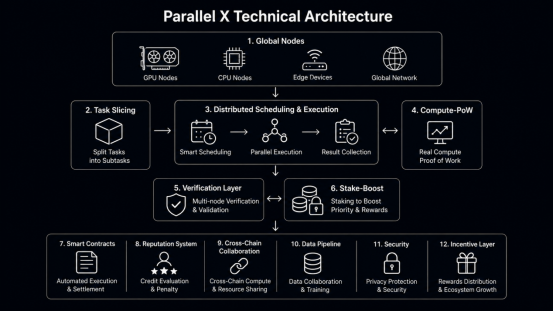
The core foundation of the Parallel X network is built on a global distributed node collaboration system. Through an open protocol, the network connects GPUs, CPUs, and edge devices, enabling hardware resources of different regions and performance tiers to jointly participate in compute task execution and form a unified parallel compute network.
Traditional centralized computing platforms typically rely on large data centers, with highly concentrated resource scheduling and closed node structures that ordinary users can hardly join. Parallel X adopts an open node model: any device that meets the operating standard can permissionlessly join the network and participate in global task collaboration through on-chain verification. This architecture not only improves resource utilization, but also lowers the barrier to participating in high-performance compute infrastructure.
During node onboarding, the system automatically completes device detection and on-chain registration. GPU model, CPU performance, memory capacity, network bandwidth, online stability, and hardware operating status are uniformly recorded to generate a node identity profile. All node data is verified through on-chain mechanisms, ensuring that the device resources in the network are genuine and trustworthy.
Different hardware devices take on different task content according to their performance tier. High-performance GPU nodes typically handle AI model training, large-scale matrix operations, and complex parallel compute tasks; CPU nodes are suited to lightweight data processing, task verification, and auxiliary computing; edge devices can participate in real-time inference, distributed data synchronization, and low-latency task execution. Nodes coordinate through a unified scheduling protocol, together forming a complete global compute network.
The Parallel X network adopts a distributed parallel compute architecture. Complex tasks are never completed by a single node alone; instead, a task-splitting mechanism assigns them to multiple nodes for simultaneous execution. The system cuts large AI training tasks, data analytics tasks, or rendering tasks into multiple independent compute segments, then distributes them dynamically based on node performance and network conditions. This model effectively improves overall execution efficiency and reduces the risk of single-point failure.
During parallel computation, nodes continuously synchronize state and report task progress. The scheduling system monitors node load, online stability, and task completion in real time, dynamically adjusting task allocation strategy according to the network's overall operating state. When some nodes go offline or their performance fluctuates, the system automatically reassigns tasks, keeping the entire network running stably.
To improve long-term node stability, Parallel X has also built a node reputation system. Based on historical contribution, task completion rate, online duration, and verification results, the system generates a dynamic reputation score for each node. High-reputation nodes gain priority access to higher-tier tasks and greater reward weight, while abnormal nodes face task restrictions and reputation penalties. This mechanism effectively improves the overall operating quality of the network.
The open node system also gives the Parallel X network greater scalability. As more GPUs and edge devices worldwide join, overall compute capacity keeps growing. The network no longer depends on data centers in a single region — it forms genuinely distributed compute infrastructure through global node collaboration.
In the future, as AI and edge intelligence continue to develop, the structure of global compute resources will become increasingly decentralized. Large numbers of devices will be capable of joining the AI collaboration network, and the open node system Parallel X is building will gradually become one of the important foundational architectures of global parallel computing.
3.2Task Slicing and the Scheduling Mechanism
In traditional computing architectures, large-scale tasks are usually executed centrally on a single server or a fixed GPU cluster. While this model provides stable performance, it tends to suffer from insufficient resource utilization, difficult scaling, and excessive compute cost when facing ultra-large AI training and complex parallel tasks. Through task slicing and dynamic scheduling, the Parallel X network achieves efficient collaborative computing among distributed nodes worldwide.
Task slicing is one of the core mechanisms of the Parallel X parallel compute system. The system splits complex compute tasks into multiple independent, verifiable compute units, then distributes them to different nodes through the on-chain scheduling protocol for simultaneous execution. Every compute segment has its own input, execution logic, and result-verification structure, ensuring tasks can run stably in an open network environment.
AI model training is the most typical application scenario. Large models involve massive parameter computation and matrix operations; relying entirely on a single GPU node would not only take extremely long but also greatly increase resource consumption. Parallel X splits a training task into multiple training modules computed simultaneously by GPU nodes around the world, with the verification layer then aggregating the results — significantly improving overall training efficiency.
Beyond AI training, rendering tasks, scientific simulations, and data analytics are equally suited to parallel slicing. Frame processing in film rendering, physics-model computation in industrial simulation, and large-scale dataset analysis can all be split and completed collaboratively by multiple nodes. This structure not only raises execution speed, but also strengthens the scalability of the entire network.
The Compute Scheduler in the Parallel X network is responsible for the entire task distribution and resource coordination process. The scheduling system analyzes node performance, online status, network latency, and historical reputation in real time, automatically matching the most suitable execution nodes to each task's complexity. High-performance GPU nodes typically take on more intensive compute content, while lightweight nodes are suited to auxiliary computing and verification tasks.
Dynamic scheduling capability is one of the Parallel X network's key advantages. Traditional platforms usually adopt fixed resource allocation, whereas Parallel X adjusts task flows in real time according to the network's overall operating state. When some nodes are overloaded or temporarily offline, the system automatically redistributes task segments, avoiding single-point bottlenecks and improving overall stability.
To guarantee authentic task execution, every compute segment carries an on-chain verification structure. After a node submits its result, the result's validity must be confirmed through multi-node cross-verification and hash checking. Only after verification passes does the system automatically distribute rewards. Any false submission, duplicate computation, or malicious behavior triggers reputation penalties and stake slashing.
Parallel X has also established a task priority system. Tasks are ranked dynamically based on resource requirements, execution tier, and network contribution. Nodes with long-term stable contribution gain priority access to higher-tier tasks, while staking users can raise their task acceptance weight through Stake-Boost. This mechanism further strengthens the network's long-term operating stability.
As the network continues to grow, Parallel X's scheduling system will keep evolving. The system will gradually introduce AI-driven dynamic scheduling models, adaptive resource allocation algorithms, and cross-chain task coordination mechanisms, further improving the utilization of global compute resources.
Task slicing and dynamic scheduling not only improve the execution efficiency of the Parallel X network — for the first time, they give scattered compute worldwide genuinely coordinated operating capability. Future large-scale AI infrastructure will increasingly rely on this open parallel computing model, and Parallel X aims to become one of the important underlying networks of this era.
3.3The Compute-PoW and Stake-Boost Model
The Parallel X network adopts a dual Compute-PoW and Stake-Boost collaboration mechanism to build the node incentive system and operating logic of the entire ecosystem. The model emphasizes the importance of real compute contribution while also using a long-term staking mechanism to strengthen network stability, creating a continuous cycle among compute resources, node behavior, and ecosystem value.
PoW in traditional blockchain networks relies on hash computation and energy consumption with no practical value, whereas the Compute-PoW (Compute Proof of Work) used by Parallel X is built on real compute tasks. The compute nodes expend is not spent on meaningless mathematical competition — it directly serves AI model training, data analytics, image rendering, and high-performance parallel computing tasks. This means every unit of compute consumed in the network converts into real, effective computational value.
The core goal of Compute-PoW is to make the network's compute resources genuinely serve real-world demand. Nodes must complete the compute tasks distributed by the system and have their results confirmed as valid through on-chain verification before receiving the corresponding rewards. Task completion quality, execution efficiency, node stability, and computational authenticity all directly affect reward weight. The system does not allocate purely by device performance — it values a node's actual contribution capacity more.
To keep the network stable over the long term, Parallel X also introduces the Stake-Boost mechanism. While providing compute resources, nodes can stake pXToken to raise their task acceptance priority and verification weight. Staking represents not only a node's willingness to participate in the network's long-term development, but also strengthens its collaborative capacity within the ecosystem.
Stake-Boost does not change the core logic of Compute-PoW; it builds a long-term incentive layer on top of real contribution. Compute contribution remains the primary basis for rewards, but high-quality nodes can gain access to higher-tier tasks through staking — forming a dual operating model of "contribution + long-term collaboration."
This mechanism effectively reduces the impact of short-term speculation on network stability. In traditional blockchain incentive systems, some nodes frequently enter and exit the network in response to short-term revenue swings, degrading overall stability. Stake-Boost encourages nodes to participate in ecosystem building over the long term, giving the network a more stable base resource structure.
Parallel X has also built a dynamic weighting system. Node revenue is not fixed; it adjusts dynamically based on device performance, task completion rate, online duration, reputation score, and stake size. Nodes that run stably over the long term with high reputation continuously receive greater weight in higher-tier task allocation.
On verification, Compute-PoW likewise introduces a multi-node cross-verification structure. After a node completes a task, its result is checked by other validator nodes to ensure the computation is genuine and valid. Any false computation, malicious submission, or duplicate task behavior triggers reputation deductions and staking penalties. This model effectively raises the credibility of the entire network.
The combination of Compute-PoW and Stake-Boost gives the Parallel X network an incentive structure that balances efficiency, security, and long-term stability. Compute contribution determines the network's operating foundation, the staking mechanism strengthens long-term ecosystem collaboration, and the on-chain verification system ensures the entire computing process is transparent and trustworthy.
In the future, as the network continues to grow, Parallel X will gradually introduce more intelligent dynamic incentive models, further optimizing task allocation, node weighting, and resource utilization — driving the continued development of the entire decentralized parallel compute network.
3.4Verifiable Compute and Smart Contract Mechanisms
In an open distributed compute network, how to guarantee authentic task execution and trustworthy results is one of the core questions of system operation. Because nodes come from different regions worldwide — with differences in device performance, operating environment, and participant identity — a unified, trusted verification system must be established to keep the entire computing process transparent, stable, and tamper-proof.
Through verifiable compute mechanisms and an on-chain smart contract system, the Parallel X network builds a complete trusted collaboration architecture. All task execution, result submission, reward distribution, and node behavior records are verified and stored on-chain, realizing a genuinely open and trustworthy compute network.
Verifiable compute is a key foundation of the Parallel X technology stack. The system generates a unique on-chain verification identifier for every task segment and continuously records node behavior and compute state throughout execution. After completing a task, a node must submit the corresponding result hash and execution proof, which the verification layer then uniformly validates.
To prevent single-node cheating, Parallel X adopts a multi-node cross-verification mechanism. Different validator nodes synchronously compare compute results and confirm their validity by combining task hashes, execution paths, and historical behavior records. Only after verification passes does the system automatically release the corresponding rewards.
This structure not only raises network credibility, but also effectively reduces the impact of malicious nodes on the ecosystem. Any false computation, result tampering, or abnormal behavior triggers on-chain penalties, including reputation deductions, task freezes, and staking penalties.
Smart contracts are the essential execution foundation of the entire network. All task scheduling, reward distribution, node management, and governance processes in Parallel X execute automatically through on-chain contracts. The system does not rely on centralized administrators for manual intervention; it runs automatically according to preset rules.
Mining pool management is likewise controlled uniformly by smart contracts. All token reward release logic, node revenue calculation, and staking weight adjustments execute automatically according to on-chain rules. No one can arbitrarily modify reward rules or mint additional tokens, ensuring the entire economic system is open and transparent.
Parallel X adheres to a "zero-permission" principle. After core contracts go live, centralized control permissions will be progressively removed, and parameter adjustment rights will be opened through DAO governance. The network's operating rules will no longer be decided by a single institution — they will be governed jointly by the community and the nodes.
On security, Parallel X adopts a multisig management structure and professional contract audits. Important upgrade operations require signatures from multiple parties to execute, avoiding single-point control risk. Core contracts also undergo regular audits by third-party security firms, raising the overall security of the system.
The on-chain record mechanism further enhances network transparency. Node contributions, task execution results, reward distribution, and governance proposals are all permanently recorded on the blockchain, where any participant can publicly query and verify them. This transparent structure effectively strengthens the long-term credibility of the entire ecosystem.
In the future, as the network continues to grow, Parallel X will gradually introduce more advanced verifiable compute technologies — including zero-knowledge proofs, off-chain compute verification, and cross-chain verification structures — further improving the efficiency of global distributed collaboration.
Verifiable compute and smart contract mechanisms give Parallel X not only high-performance parallel computing capability, but also the trusted collaboration foundation essential to an open network environment. This structure will become an important component of future decentralized AI infrastructure.
3.5The Cross-Chain Compute Coordination System
As the blockchain ecosystem keeps expanding, demand for collaboration among different public chains, Layer2 networks, and distributed applications continues to grow. Future AI and high-performance computing tasks will not exist within a single on-chain system; they will gradually spread across multiple ecosystem networks. How to achieve compute interoperability and task collaboration between chains is becoming an important direction in the development of decentralized compute networks.
The cross-chain compute coordination system Parallel X is building aims to break down resource barriers between on-chain ecosystems, allowing global compute resources to flow across networks and form a unified scheduling system. AI projects, data protocols, and distributed applications on different chains can all call on global compute resources through the Parallel X network, establishing genuinely open cross-chain compute infrastructure.
Traditional blockchain networks usually operate as independent structures, and data and resources are hard to move directly between chains. This means some ecosystems may have abundant application demand but lack sufficient compute, while other networks hold large numbers of idle nodes that cannot participate in external task collaboration. This resource fragmentation is limiting the further development of the entire Web3 and AI ecosystem.
Through a cross-chain compute bridge and a unified scheduling protocol, Parallel X achieves task synchronization and resource sharing across networks. The system can bring compute requests from different chains into the Parallel X network under one roof, then distribute them through the scheduling layer to nodes worldwide for execution.
During cross-chain task execution, the system generates a unified on-chain mapping structure for every task. Task origin, executing nodes, verification results, and reward settlement information are all recorded synchronously through cross-chain verification mechanisms, ensuring data consistency and execution credibility across networks.
On rewards, Parallel X supports a multi-ecosystem settlement structure. Some tasks can be paid in native ecosystem tokens, while node revenue can flow back through the cross-chain bridge to the pXToken network for unified on-chain settlement. This model not only strengthens token circulation, but also further improves the openness of the entire ecosystem.
As Layer2 and multi-chain structures continue to develop, large numbers of future AI applications will be distributed across different network environments. Parallel X's cross-chain coordination system will provide these ecosystems with unified compute infrastructure, enabling genuinely shared resource systems between chains.
The development of edge intelligence also gives cross-chain collaboration broader application space. Future IoT devices, mobile terminals, and edge nodes may each run in different on-chain environments. Through a unified cross-chain protocol, Parallel X lets these devices jointly participate in the global AI compute network, achieving real-time coordination and dynamic scheduling.
To keep cross-chain processes secure, Parallel X adopts multiple verification mechanisms, including cross-chain message confirmation, task hash checking, and multi-node verification structures. Any abnormal data or malicious operation triggers on-chain risk-control mechanisms, improving overall system stability.
In the future, Parallel X will gradually become compatible with more public chain ecosystems and Layer2 networks, and will explore new scenarios such as AI Agent collaboration, on-chain data training, and cross-chain model deployment. As global Web3 and AI infrastructure continue to converge, cross-chain compute networks will gradually become one of the essential underlying capabilities of the future digital economy.
CHAPTER 04
Platform Ecosystem and Business Modules
4.1Node Tiers and the Reward System
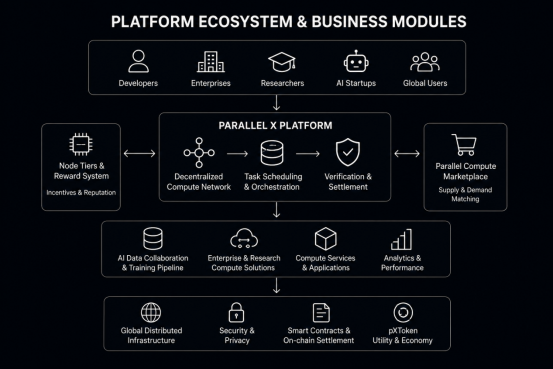
The Parallel X network runs on the sustained, stable collaboration of nodes worldwide. To improve overall network efficiency and ensure different compute resources can fairly participate in task execution under unified rules, Parallel X has built a complete node tier and dynamic reward system. The system considers not only node hardware performance, but places even greater weight on long-term contribution, online stability, and collaboration quality — forming a sustainable distributed compute ecosystem.
In the network, every node automatically receives an on-chain identity profile upon registration. Data such as GPU performance, CPU capability, memory capacity, network bandwidth, online duration, and task execution history is continuously recorded and dynamically updated. Using this data, the system builds a comprehensive evaluation model and assigns each node a corresponding tier.
Node tiers are not fixed; they change continuously with network contribution. Nodes that run stably over the long term, maintain high task completion rates, and hold good reputation gradually rise in tier and gain priority access to higher-tier task allocation. Some high-performance nodes can also take part in core AI training tasks and advanced verification tasks, earning higher revenue.
Parallel X's reward system is built on real contribution. Node revenue comes mainly from Compute-PoW compute contribution rewards and Stake-Boost staking-enhanced revenue. The system automatically calculates reward ratios based on task complexity, compute duration, resource occupancy, and result verification. Nodes do not gain absolute monopoly advantage from hardware scale alone — long-term stable collaboration capacity is an equally important evaluation metric.
Online stability is an important component of node rating. Tasks in a distributed network typically require multiple nodes to execute in coordination; if some nodes frequently go offline or interrupt operation, overall task efficiency suffers directly. The system therefore continuously monitors node online status and task response speed, feeding both into the dynamic reputation scoring system.
The reputation mechanism further strengthens the security of the entire network. If a node exhibits abnormal behavior — including duplicate submissions, false computation, malicious verification, or prolonged task interruption — the system automatically lowers its reputation tier and reduces its task allocation weight. Severely violating nodes may also trigger staking penalties and task freeze mechanisms.
To encourage long-term ecosystem participation, Parallel X has also built a growth-oriented reward structure. As node operating time increases and historical contribution accumulates, some long-term stable nodes gradually gain additional weight bonuses. This mechanism strengthens the stability of the network's base resources and reduces the impact of short-term speculation on the ecosystem.
In future network expansion, Parallel X will gradually introduce more intelligent node rating models, including AI-driven dynamic reputation evaluation, task-fit algorithms, and global resource coordination optimization. The system will automatically match the most suitable task types to each node's capabilities, further improving overall compute utilization.
The node tier and reward system is not only the incentive structure of the Parallel X network — it is also an important guarantee of stable ecosystem operation. By combining real contribution, dynamic reputation, and long-term collaboration mechanisms, the network forms a fairer, more efficient, and more sustainable global distributed compute system.
4.2The Parallel Compute Marketplace
As demand for artificial intelligence, large-model training, and high-performance computing keeps growing, the global market's appetite for elastic compute resources continues to expand. More and more enterprises, development teams, and research institutions need to obtain large amounts of GPU and parallel compute capacity on short notice for model training, data processing, and complex computation. Traditional centralized cloud platforms, however, are not only costly — they also suffer from resource concentration and scheduling constraints.
The parallel compute rental marketplace Parallel X is building aims to establish an open, transparent, and global distributed compute trading system. Any user with compute needs can call on global node resources through the network, and any device with idle compute can join the Parallel X network, participate in task execution, and earn revenue.
The entire marketplace runs on a decentralized coordination structure. After an enterprise or developer submits a compute request, the system automatically analyzes task scale, compute type, and resource requirements, then splits the task into multiple compute segments through the scheduling protocol and distributes them to nodes worldwide for simultaneous execution. Compared with traditional centralized GPU clusters, this model offers greater scalability and resource elasticity.
AI model training is one of the most important application scenarios today. As model parameter counts keep growing, a single data center often cannot meet large-scale training demand at low cost. The Parallel X network can execute training tasks through the collaboration of GPU nodes worldwide, reducing overall training cost and improving resource utilization.
Film rendering and digital content generation are likewise important business directions. Video rendering typically requires long-running parallel GPU computation, and the Parallel X network can distribute rendering tasks across multiple nodes for simultaneous completion, dramatically shortening overall render cycles. For the digital content industry, this model effectively raises production efficiency.
Research institutions also have enormous demand for high-performance computing. Climate simulation, biocomputing, drug discovery, and complex industrial simulation all require extensive parallel computation. Through its open compute marketplace, Parallel X hopes to give more research teams access to global compute resources at lower cost.
On transaction structure, all task settlement is completed automatically through on-chain mechanisms. The task initiator pays fees according to resource consumption, and nodes earn rewards according to actual contribution. The entire process executes automatically through smart contracts, avoiding the human intervention and opacity found in traditional platforms.
Parallel X also supports a dynamic resource pricing mechanism. Different node tiers, task types, and resource demands form a dynamic price structure. This model reflects market supply and demand more truthfully and improves the resource utilization of the entire network.
To guarantee task execution quality, the system continuously monitors node performance and compute results. High-reputation nodes gain access to higher-tier tasks, while abnormal nodes face resource restrictions and reputation deductions. This mechanism effectively improves the stability and credibility of the entire marketplace.
In the future, Parallel X will gradually expand into more compute service scenarios, including AI Agent collaboration, edge inference, on-chain data training, and cross-chain AI services. As global AI infrastructure continues to develop, the decentralized compute rental marketplace will gradually become an important component of the digital economy.
4.3AI Data Collaboration and Training Pipelines
The development of artificial intelligence depends not only on high-performance compute resources, but also heavily on large-scale data collaboration capacity. AI model training requires continuously processing massive datasets and iteratively optimizing model parameters through complex computation. As model scale and data volume grow rapidly, traditional centralized training approaches face problems of insufficient data processing efficiency, difficult resource scheduling, and excessive collaboration cost.
Through a distributed data collaboration and training pipeline system, the Parallel X network builds open AI training infrastructure. The network not only provides parallel compute resources, but also enables the full collaboration workflow — data sharding, training synchronization, model verification, and on-chain attestation — improving both the efficiency and credibility of AI training.
In the Parallel X network, large-scale data is not stored centrally on a single server; it is distributed across different nodes through a sharding mechanism. Based on task structure and node capability, the system cuts training data into multiple independent parts processed simultaneously by different nodes. This model effectively reduces single-node load and improves overall training efficiency.
The data sharding mechanism also strengthens network security. Traditional centralized data storage is an easy attack target, whereas a distributed structure reduces single-point risk. Each node processes only part of the data and coordinates task completion through on-chain verification structures, improving the stability of the entire training system.
During AI model training, Parallel X adopts gradient synchronization and multi-node verification mechanisms. After completing local training, each node submits its training results to the verification layer for unified aggregation. The system confirms result validity through cross-verification and on-chain checking, then automatically updates the overall model parameters.
To keep the training process transparent and trustworthy, all model training records, task execution states, and result verification information form traceable records on-chain. Any participant can verify the model training process, raising the credibility of the entire AI collaboration system.
Parallel X also supports an on-chain model registration mechanism. A trained AI model can generate a corresponding on-chain identity and version record, enabling traceable model management. This structure not only helps protect model copyright, but also strengthens the circulation capacity of AI assets.
The development of edge intelligence also gives distributed training broader space. In the future, large numbers of AI inference tasks will occur on edge devices, and the Parallel X network lets these devices jointly participate in data synchronization and model collaboration, forming a distributed AI network covering the globe.
To protect data privacy, Parallel X will also gradually introduce privacy computing, zero-knowledge proofs, federated learning, and other technical structures. Nodes can participate in model training and collaborative computation without exposing raw data content, further strengthening network security.
AI data collaboration and training pipelines not only improve the compute capacity of the Parallel X network — they also give the entire ecosystem more complete AI infrastructure properties. As AI and Web3 integrate ever more deeply, open training networks will gradually become an important component of the global digital economy.
4.4Enterprise and Research Compute Scenarios
As global digitization continues to accelerate, high-performance computing has gradually become an essential foundational resource for enterprises and research institutions. Whether AI training, industrial simulation, or large-scale data analytics, more and more industries need stable, scalable compute capacity. Traditional centralized compute systems, however, suffer from high cost, constrained resource scheduling, and long expansion cycles — no longer able to fully meet future market demand.
The Parallel X network serves not only the open node ecosystem, but also enterprise-grade and research-grade high-performance computing scenarios. Through its global distributed node collaboration system, the network provides institutions of all kinds with more flexible, open, and scalable parallel compute resources.
AI companies are among Parallel X's most important potential user groups. As large-model training scale keeps expanding, training cycles and resource consumption grow rapidly. Some AI projects need to call on large numbers of GPUs running for extended periods during training, and traditional cloud platforms are often extremely expensive. The Parallel X network can execute training tasks through the collaboration of GPU nodes worldwide, reducing overall training spend and improving resource utilization.
Automated inference and real-time AI services likewise require stable compute support. Intelligent customer service, AI Agents, autonomous driving, and vision recognition systems all depend on continuously running inference networks. Through edge nodes and its global distributed structure, Parallel X can provide low-latency compute support for these scenarios.
Research demand for parallel computing is equally enormous. Molecular simulation, gene analysis, and drug discovery in biomedicine typically require extremely high compute capacity; climate simulation, energy forecasting, and complex physics experiments likewise depend on long-running parallel computation. Through its open network, Parallel X hopes to give more research institutions access to high-performance compute resources at lower cost.
Industrial manufacturing scenarios are also gradually entering the era of intelligent computing. Complex industrial simulation, digital twins, and automated control systems all require extensive real-time data processing and parallel analysis. Through its dynamic scheduling mechanism, the Parallel X network can provide industrial systems with more flexible resource support.
The financial industry likewise has enormous demand for high-frequency data analytics and quantitative computation. Risk model analysis, market forecasting, and real-time trading strategies all depend on high-speed parallel computing. Through its global node collaboration system, Parallel X can help certain financial computing scenarios reduce the cost of resource expansion.
On enterprise service structure, Parallel X supports flexible resource invocation. Institutions can rent compute resources dynamically according to task scale, without building expensive infrastructure for the long term. This model not only lowers the barrier for enterprises, but also significantly improves resource utilization.
In the future, as AI, the industrial internet, and intelligent scientific research continue to develop, demand for high-performance computing will keep growing. Through its open global collaboration network, Parallel X hopes to build more efficient, trustworthy, and scalable new compute infrastructure for enterprises and research institutions.
CHAPTER 05
The pXToken Economic Model
5.1Token Fundamentals and Issuance Mechanism
pXToken (Parallel X Token) is the core value carrier of the Parallel X network and an important foundation for the operation of the entire decentralized parallel compute ecosystem. The token not only powers node incentives, task settlement, and network governance — it is also a key medium connecting global compute resources with AI compute demand.
In the Parallel X network, all node contributions, task execution, and ecosystem collaboration behavior realize value transfer through pXToken. Through a unified on-chain economic system, the network aims to turn scattered compute resources worldwide into verifiable, quantifiable, and circulating digital assets, establishing a long-term stable decentralized compute ecosystem.
pXToken has a fixed total supply of 100,000,000 tokens and operates under a constant-supply mechanism. The ecosystem has no additional issuance and no centralized unlimited minting authority. The fixed-supply structure guarantees long-term supply stability and reduces the dilution that traditional inflationary models inflict on ecosystem value.
The network adopts a single mining-pool release mechanism. All tokens enter the market gradually through node contribution, task execution, and ecosystem collaboration — not in a one-time concentrated release. This means the growth of token circulation stays in step with the network's development scale, avoiding the market imbalance that rapid large-scale circulation would bring.
Parallel X adheres to the principle of "contribution-driven release." Tokens do not generate yield from passive holding alone; a node earns corresponding rewards only by actually participating in compute tasks, providing network resources, or joining ecosystem collaboration. The entire system emphasizes real contribution value rather than short-term speculative structure.
On issuance logic, Compute-PoW is the essential basis of token release. After a node completes AI training, data processing, verification computing, or parallel tasks, the system automatically allocates the corresponding token rewards based on actual contribution. Task type, node tier, and execution quality all directly affect reward weight.
The Stake-Boost mechanism further strengthens long-term ecosystem stability. By staking pXToken, nodes not only raise their task acceptance weight, but also enhance their verification participation eligibility and revenue capacity. This structure makes the token not just a medium of circulation, but also an important base resource for network collaboration.
To keep the entire ecosystem open and transparent, all token release logic executes automatically through on-chain smart contracts. Reward distribution, node weighting, and task revenue settlement all run according to preset rules, avoiding centralized human intervention. Any participant can query token circulation and reward structure through on-chain data.
Parallel X also emphasizes long-term ecosystem balance. Token value does not depend on isolated market behavior; it is deeply bound to real compute demand, network scale, and AI compute resource consumption. As the number of network tasks grows, demand for the token in task settlement and resource leasing will continue to expand.
In the future, as global AI infrastructure continues to develop, pXToken will not only carry value transfer within the network — it may also gradually become an important resource credential in the distributed compute ecosystem. Through an open, fair, and long-term sustainable economic model, Parallel X aims to drive the network toward a genuinely stable global compute collaboration system.
5.2The Compute-PoW Node Incentive Mechanism
The Parallel X network adopts Compute-PoW (Compute Proof of Work) as the core incentive mechanism of the entire ecosystem. Unlike PoW models in traditional blockchains that rely on hash competition with no practical value, Compute-PoW emphasizes real compute contribution and actual resource value — every unit of compute a node expends directly serves real-world AI and high-performance computing demand.
In traditional PoW networks, large amounts of energy and hardware are spent on repetitive mathematical operations that typically produce no real-world application value. Parallel X aims to change this model. Nodes in the network do not merely compete in hashing — they directly undertake real tasks such as AI model training, data processing, parallel rendering, and verification computing.
After joining the network, a node is dynamically assigned task content based on device performance, online status, and historical reputation. GPU nodes typically take on high-intensity AI training and matrix operation tasks; CPU nodes suit verification computing and auxiliary processing scenarios; edge devices can participate in real-time inference and distributed coordination tasks. Together, different nodes form a complete parallel compute network.
Compute-PoW's reward logic is built on real contribution. After completing a task, a node must have its result confirmed as valid through on-chain verification before the system automatically releases the corresponding token reward. Task complexity, resource occupancy, compute duration, and result accuracy all directly affect the revenue ratio.
To prevent resource monopolization, Parallel X does not allocate revenue absolutely by hardware scale alone. Nodes that stay stably online over the long term, maintain high task completion rates, and hold good reputation likewise gain access to higher-tier tasks. This mechanism improves fairness across the ecosystem and encourages more nodes to participate in network operation for the long term.
The dynamic task scheduling mechanism further enhances Compute-PoW's resource utilization. The system monitors node load and network state in real time, automatically adjusting resource allocation structure according to task demand. When some nodes go offline or become overloaded, the system automatically redistributes tasks, keeping the entire network running stably.
To improve computational authenticity, Parallel X also adopts a multi-node cross-verification mechanism. After task results are submitted, they must be synchronously checked by other validator nodes. Any false submission, malicious tampering, or duplicate computation triggers reputation penalties and stake slashing.
Compute-PoW is not only a reward structure — it is also an important operating foundation of the entire Parallel X network. As global AI demand keeps growing, more and more real compute tasks will enter the network ecosystem, and token release will stay continuously in step with actual compute demand.
This model deeply connects Parallel X's economic system with the real compute market. Network value no longer depends purely on market sentiment — it is built on real AI and high-performance computing demand. The more tasks there are, the greater the node contribution, and the network's resource flows and token usage demand grow continuously.
In the future, as the Parallel X network continues to grow, Compute-PoW will gradually connect to more AI and distributed collaboration scenarios — including AI Agent computing, on-chain inference services, and edge intelligence networks — further strengthening the ecosystem's long-term development capacity.
5.3The Stake-Boost Staking Enhancement Mechanism
In a decentralized compute network, relying solely on short-term task incentives often fails to guarantee long-term stable ecosystem operation. Some nodes may frequently enter and exit the network in response to market swings, destabilizing the overall resource structure. To strengthen nodes' long-term collaboration capacity and build a more solid ecosystem foundation, Parallel X introduces the Stake-Boost staking enhancement mechanism.
The core goal of Stake-Boost is to let token holders not only participate in network circulation, but also strengthen ecosystem stability through long-term staking. While providing compute resources, nodes can choose to stake pXToken, thereby raising their task acceptance weight, verification participation eligibility, and overall revenue capacity.
Task allocation in the Parallel X network is not a completely random structure. The system comprehensively weighs node performance, reputation score, online stability, and staking weight to dynamically match task resources. Nodes with long-term stable staking gain access to higher-tier tasks, forming a cycle of "long-term collaboration — resource enhancement — revenue growth."
Stake-Boost does not replace Compute-PoW; it is an enhancement mechanism built on real contribution. The system still treats a node's actual compute contribution as the primary basis for rewards, with staking used only to raise collaboration weight and long-term ecosystem participation capacity. This model effectively avoids the resource imbalance that a purely financialized staking structure would inflict on the network.
The staking mechanism also strengthens network security. When participating in higher-tier tasks or verification processes, nodes take on certain on-chain responsibilities. If a node acts maliciously — including false verification, task tampering, or prolonged abnormal operation — the system triggers the staking penalty mechanism, reducing the damage malicious nodes can do to the network.
To preserve ecosystem liquidity, Parallel X adopts a dynamic staking structure. Different node tiers, task types, and network phases each form corresponding staking weight models. The system continuously optimizes parameters according to the network's overall operating state, maintaining both resource utilization and ecosystem balance.
Nodes that participate in network building over the long term also gradually accumulate additional reputation bonuses. As operating time increases and historical contribution grows, some high-reputation nodes gain higher collaboration tiers and priority access to core tasks and advanced verification processes. This mechanism strengthens the long-term stability of the entire ecosystem.
Stake-Boost is also an important foundation of the Parallel DAO governance system. Part of the on-chain governance weight is tied to nodes' long-term contribution and stake size, giving nodes that genuinely participate in ecosystem building over the long term greater governance capacity. This means the network's future direction will increasingly be decided jointly by its long-term contributors.
As the Parallel X network continues to expand, the Stake-Boost mechanism will keep evolving. The system may gradually introduce dynamic reputation staking models, AI risk assessment structures, and cross-chain collaborative staking mechanisms, further strengthening the stable operating capacity of the entire ecosystem.
Stake-Boost makes pXToken not merely a circulating asset, but also an important base resource for long-term network collaboration. Nodes participate in ecosystem building through staking, and the network, through long-term collaboration, forms an ever more stable global parallel compute system.
5.4Token Use Cases and Circulation Logic
pXToken is the core value medium of the Parallel X network, running through the entire operating system of the ecosystem. The token not only powers node rewards and resource settlement — it is also an important base resource connecting the compute marketplace, AI tasks, and governance collaboration. As the network continues to grow, pXToken's use cases will keep expanding, gradually forming a complete ecosystem circulation structure.
In the Parallel X network, the most fundamental use case is task settlement. When enterprises, developers, or research institutions call on the network's compute resources, they pay the corresponding compute fees in pXToken. Each task forms a dynamic cost structure based on resource consumption, execution duration, and compute complexity, while nodes earn corresponding rewards based on actual contribution.
AI model training is one of the important sources of token consumption. As AI training demand keeps growing, large amounts of GPU and parallel compute resources continuously enter the market collaboration system. The more training tasks there are, the more token circulation demand in the network expands — forming a value structure deeply bound to the real compute market.
Node staking is another core use case. Nodes participating in Compute-PoW can stake pXToken to raise their task acceptance weight and verification participation eligibility. Staking not only strengthens network stability, but also reduces short-term liquidity sell pressure, forming a more stable ecosystem operating structure.
The Parallel DAO governance system is likewise built on the token. Community proposals, parameter adjustments, and ecosystem development direction will gradually open to on-chain governance. Nodes and users who participate in network building over the long term can join governance collaboration by holding and staking pXToken, driving the network toward progressive decentralized autonomy.
The development of the cross-chain compute ecosystem will further expand the token's application scope. In the future, AI projects on different public chains and Layer2 networks will be able to call on global compute resources through Parallel X, with pXToken serving as the unified settlement and collaboration medium. As cross-chain coordination scale grows, the token's ecosystem circulation capacity will strengthen further.
On circulation logic, Parallel X emphasizes a "contribution — consumption — return" ecosystem loop. Nodes earn tokens by contributing compute; enterprises and developers consume tokens to obtain compute resources; and part of the revenue flows back into the network through staking, governance, and ecosystem collaboration. This structure strengthens the long-term stability of the entire economic system.
To avoid the value dilution of traditional high-inflation models, Parallel X adheres to a fixed-supply mechanism. Tokens are not minted infinitely; they are released into the market gradually alongside real compute tasks. Network value growth will likewise depend more on actual AI and compute demand than on pure market speculation.
In the future, as the Parallel X network continues to expand, pXToken may also gradually connect to more Web3 and AI application scenarios — including AI Agent services, on-chain inference networks, edge intelligence collaboration, and decentralized data marketplaces — further strengthening the value support of the entire ecosystem.
pXToken's goal is not merely to become a payment tool within the network, but to gradually develop into a core resource credential in the decentralized AI infrastructure of the future — letting global compute collaboration genuinely form an open, transparent, and sustainable value system.
5.5Value Cycles and the Ecosystem Loop
The long-term development of the Parallel X network does not depend on isolated market behavior or short-term traffic growth — it is built on real compute demand and sustained ecosystem collaboration. The entire pXToken economic system emphasizes "real compute value driving," and through a complete value-cycle structure, token circulation, node contribution, and task demand form a long-term stable ecosystem loop.
In traditional blockchain ecosystems, some token models long lack real use cases, with value depending mainly on market sentiment swings. Once new capital inflow dries up, the ecosystem easily loses its long-term support. Through real AI and high-performance computing demand, Parallel X aims to build a more stable value structure with sustained growth capacity.
The network's value cycle starts from the world's ever-growing compute demand. AI model training, data processing, industrial simulation, edge intelligence, and parallel rendering tasks continuously consume the network's GPU and compute resources. Enterprises, developers, and research institutions obtain the corresponding compute services by paying pXToken.
Nodes provide compute capacity by participating in Compute-PoW and earn token rewards based on actual contribution. As task scale grows, more nodes join the network to collaborate, forming a global distributed compute resource system. Compute demand drives resource growth, and resource growth in turn strengthens the network's overall service capacity.
The Stake-Boost mechanism further strengthens the stability of the entire ecosystem. After earning revenue, some nodes choose to keep staking tokens to participate in long-term collaboration, raising their own task tier and verification weight. This means part of the circulating tokens re-enter the network's staking system, reducing short-term market liquidity pressure.
The governance system is likewise an important component of value return. As Parallel DAO gradually opens up, nodes and users who participate in network building over the long term take part in on-chain governance through the token. Governance participation rights are deeply bound to long-term contribution, orienting the entire ecosystem toward long-term collaboration rather than short-term speculation.
The development of the cross-chain ecosystem also continuously enlarges the entire value cycle. In the future, different public chains, AI protocols, and Web3 applications will all be able to call on compute resources through Parallel X and settle them uniformly in pXToken. As the number of connected ecosystems grows, the token's circulation capacity across networks will expand further.
Parallel X also emphasizes the correspondence between real resource consumption and token circulation. Every use of the token in the network corresponds to a real compute task and real resource consumption behind it. This means token value growth does not float free of real-world demand — it is deeply bound to the development of global AI infrastructure.
As the AI industry continues to expand, global compute demand will keep growing for the long term. More and more enterprises and applications will rely on distributed parallel compute networks, and the open collaboration system Parallel X has built will gradually form an ever-larger ecosystem.
In the future, through a complete value-cycle structure, Parallel X hopes to let global compute resources genuinely collaborate freely. Node contribution, task demand, token circulation, and governance participation will together form a long-term stable ecosystem loop — driving the network's continued expansion and gradually making it an important component of future AI infrastructure.
CHAPTER 06
Governance and Security Mechanisms
6.1The Parallel DAO Governance Mechanism
The long-term goal of the Parallel X network is not merely to build a decentralized parallel computing platform, but to construct a global compute ecosystem capable of continuously running, collaborating, and governing itself. As network scale keeps expanding and node count keeps growing, traditional centralized management models will struggle to meet the development needs of a future open network. Parallel X will therefore progressively evolve the entire ecosystem toward a DAO (Decentralized Autonomous Organization).
Parallel DAO is the important governance foundation of the network's future. The network's core rules, parameter adjustments, ecosystem upgrades, and resource allocation direction will gradually be decided jointly by the community and the nodes, rather than being controlled long-term by a single team. Through on-chain governance mechanisms, nodes and ecosystem participants in different regions worldwide can jointly drive the continued development of the Parallel X network.
In the network's early stage, the core team will be responsible for base protocol maintenance, node operation optimization, and technical architecture upgrades, ensuring the ecosystem can grow stably. As the network matures, more and more governance authority will gradually open to the community. Certain key parameters — including task scheduling rules, reward ratios, node tier mechanisms, and ecosystem development proposals — will all enter the DAO governance system.
Governance weight will not be decided purely by token holdings. Parallel X places greater weight on long-term contribution and ecosystem participation capacity. A node's historical contribution, online stability, stake size, and long-term collaboration record all affect its governance participation weight. This structure reduces the influence of short-term speculation on the governance system and strengthens the voice of long-term builders in the ecosystem.
Community proposals are one of the core operating mechanisms of Parallel DAO. Any node or user meeting the governance standard can submit development suggestions to the network — including technical upgrades, ecosystem partnerships, resource optimization, and governance rule adjustments. Once a proposal enters the on-chain process, the community discusses and votes on it together.
The on-chain voting mechanism keeps the entire governance process open and transparent. All governance records, proposal outcomes, and parameter adjustment information are permanently recorded on the blockchain, where any participant can query and verify them. This structure effectively improves the credibility and openness of the entire ecosystem.
To prevent the governance system from being monopolized by a few nodes, Parallel DAO will gradually introduce a multi-layer governance structure. Different node types, developers, ecosystem partners, and long-term contributing users will each hold corresponding roles in the governance system, forming a more balanced community collaboration ecosystem.
Parallel X also hopes to drive global community building through the DAO mechanism. In the future, node communities in different countries and regions will gradually form regional collaboration organizations, jointly participating in ecosystem promotion, technical support, and resource expansion. Nodes worldwide will no longer be merely resource providers — together they form an open digital infrastructure network.
As the network continues to expand, Parallel DAO will gradually become the core management structure of the entire ecosystem. Protocol upgrades, resource coordination, and future development direction will all evolve continuously under community governance mechanisms. Through this open collaboration model, Parallel X aims to let the global compute network genuinely achieve long-term autonomy and sustainable development.
6.2Community Proposals and On-Chain Voting
The long-term stable operation of an open network cannot do without community participation and governance transparency. From the very beginning of its design, the Parallel X network set out to build a collaboration system in which nodes worldwide can jointly participate in decision-making — rather than relying on a single management institution to control the ecosystem's direction long-term. Community proposals and the on-chain voting mechanism are core components of the entire Parallel DAO system.
In traditional centralized platforms, protocol updates, rule adjustments, and resource allocation are usually decided unilaterally by the platform, and ordinary participants can hardly influence network development. Through open governance mechanisms, Parallel X lets nodes, developers, and long-term contributors in the ecosystem jointly participate in important decisions, forming a fairer and more transparent collaboration structure.
The community proposal mechanism allows qualified nodes or users to submit governance suggestions to the network. Proposal content can span protocol upgrades, node rule optimization, reward structure adjustments, ecosystem partnership plans, cross-chain coordination schemes, and more. Any suggestion that advances the network's long-term development has the opportunity to enter the governance process.
To preserve governance efficiency, Parallel X establishes proposal review and tiering mechanisms. Some basic proposals can quickly enter the community discussion stage, while proposals involving core protocol changes or important economic parameter adjustments must meet higher governance thresholds. This structure prevents large volumes of invalid proposals from dragging down the ecosystem's operating efficiency.
On-chain voting is the core execution method of the Parallel X governance system. Once a proposal enters the formal governance process, community nodes vote publicly on-chain. The voting result directly determines whether the proposal passes and whether the corresponding rules formally take effect.
Parallel X's voting system does not adopt a simple token-count decision model. The system comprehensively weighs nodes' long-term contribution, historical reputation, stake size, and ecosystem participation to form a more reasonable governance weight structure. This model effectively reduces the outsized influence of short-term capital on governance outcomes.
All voting data is permanently recorded on-chain. Proposal content, participating addresses, voting results, and execution status are all publicly queryable and verifiable. This means the entire governance process is fully transparent, and no one can tamper with historical governance records.
To strengthen community activity, Parallel X will also gradually build an ecosystem-incentivized governance system. Users who participate in governance voting over the long term, submit effective proposals, and advance ecosystem building may receive additional contribution rewards and community rights. This structure further strengthens the collaborative capacity of the entire DAO.
Global community coordination is likewise an important direction of the governance system. As network scale keeps growing, node counts in different regions will continue to increase. In the future, Parallel X may gradually form regional governance communities, where nodes in different countries and regions run autonomous operations around local ecosystem building, resource expansion, and technical collaboration.
The community proposal and on-chain voting mechanisms not only improve Parallel X's governance transparency — they also give the entire network genuinely decentralized autonomous capacity. In the future, the ecosystem's direction will depend increasingly on the joint collaboration of nodes worldwide, rather than being pushed unilaterally by a centralized team.
6.3Node Reputation and Behavior Management
In an open distributed compute network, node count may keep growing rapidly, while device performance, operating stability, and behavior quality differ markedly between nodes. Without a unified management mechanism, some malicious nodes could undermine network stability through false computation, abnormal verification, or malicious task interruption. Establishing a complete reputation and behavior management system is therefore an important foundation for the long-term stable operation of the Parallel X network.
Every node in the Parallel X network generates a corresponding on-chain identity profile after joining. The node's hardware performance, online duration, task completion rate, verification accuracy, and historical collaboration record are continuously recorded and dynamically updated by the system. Using this data, the system builds a node reputation scoring model that serves as an important basis for subsequent task allocation.
Reputation tier directly affects a node's collaborative capacity in the network. High-reputation nodes gain priority access to advanced tasks and higher-revenue compute resources, along with greater verification participation eligibility. Nodes that run abnormally over the long term, frequently interrupt tasks, or act maliciously face task restrictions and weight reductions.
Task completion rate is one of the important evaluation criteria in the reputation system. Distributed parallel computing usually requires multiple nodes to collaborate in sync; if some nodes frequently interrupt tasks, overall execution efficiency suffers directly. The system therefore focuses on monitoring node task stability and treats long-term online capacity as a core evaluation metric.
Verification accuracy is used to improve network credibility. Parallel X adopts a multi-node cross-verification mechanism: after a node submits task results, other validator nodes must synchronously confirm them. If some nodes repeatedly make erroneous submissions or exhibit abnormal verification behavior, the system automatically lowers their reputation tier and reduces future task allocation.
For malicious behavior, Parallel X has built a complete penalty mechanism. False computation, malicious result tampering, duplicate task submission, and abnormal resource occupation all trigger the on-chain risk-control system. Some severely violating nodes may even be restricted from core tasks or permanently removed from the network.
The Stake-Boost mechanism is also deeply bound to the node reputation system. Certain higher-tier tasks require a node to hold a certain stake size and reputation tier before it can participate in execution and verification. This structure effectively improves network security and strengthens long-term collaboration stability.
Parallel X also plans to gradually introduce AI behavior analysis models. In the future, the system will be able to identify abnormal node behavior through dynamic data analysis and automatically adjust task allocation and risk weighting. This intelligent management structure will further strengthen the security capacity of the entire network.
As the number of nodes worldwide keeps increasing, the complexity of collaboration within the network will also keep rising. Through its long-term reputation system and dynamic behavior management mechanisms, Parallel X aims to keep the entire ecosystem running stably, efficiently, and credibly at all times.
Node reputation and behavior management is not merely a risk-control tool — it is an important foundation of the entire Parallel X decentralized collaboration system. Only by building a long-term credible node ecosystem can the global parallel compute network genuinely form a sustainable open infrastructure.
6.4Smart Contracts and Multisig Security
As a global distributed parallel compute infrastructure, the Parallel X network needs its core operating logic to rest on a highly transparent and trustworthy technical structure. To ensure task scheduling, reward distribution, and ecosystem governance can run stably over the long term, Parallel X builds the network's important execution processes on a smart contract system and strengthens overall ecosystem security through a multisig security mechanism.
Smart contracts are the core execution foundation of the Parallel X network. All node rewards, task settlement, staking logic, and governance processes run automatically through on-chain contracts. The system does not rely on centralized manual management; it executes automatically according to preset rules, reducing the risk of human intervention.
During task execution, after a node completes computation, the system automatically calculates the corresponding reward based on the on-chain verification result and distributes tokens through the smart contract. The entire process is open and transparent, and any participant can query task status and revenue records through on-chain data.
The mining pool release mechanism is likewise controlled uniformly by smart contracts. Token release speed, reward ratios, and node weight calculation all execute automatically according to fixed rules. Parallel X retains no centralized unlimited modification authority, ensuring the long-term stability of the entire economic system.
The multisig security mechanism protects the network's core management permissions. Certain important operations involving protocol upgrades, parameter adjustments, and ecosystem fund management require confirmation from multiple independent signatures before execution. This structure effectively reduces single-point control risk and improves the security of the entire ecosystem.
In the network's early stage, the core team is responsible for base protocol maintenance and technical upgrades. But as the Parallel DAO governance system matures, more and more management authority will transfer into the community governance structure. In the future, important upgrades and parameter modifications will gradually be decided jointly by community voting and the multisig mechanism.
To reduce potential security risk, Parallel X undergoes regular third-party security audits. Before core smart contracts go live, they pass through multiple rounds of code review and risk testing, preventing contract vulnerabilities from affecting ecosystem operation. As the network continues to develop, the system will also keep upgrading its security structures and verification mechanisms.
In the future, Parallel X also plans to gradually introduce off-chain verification, zero-knowledge proofs, and modular security architectures, further improving the network's attack resistance and scalability.
The smart contract and multisig security system gives the Parallel X network not only open collaboration capacity, but also the trusted technical foundation required for long-term stable operation. This structure will become an important security pillar of future decentralized AI infrastructure.
CHAPTER 07
Development Roadmap
7.1Phase One: Base Network and Node Launch
The construction of the Parallel X network begins with building the base compute network as the starting point of the entire ecosystem's development. The core goal of this phase is to complete base protocol deployment, bring the node system online, and get the Compute-PoW base framework running — establishing a stable foundation for the subsequent expansion of the global parallel compute ecosystem.
In the network's initial stage, Parallel X will complete development of the core on-chain protocol and the node onboarding system. GPUs, CPUs, and edge devices will be able to join the network through a unified protocol and complete on-chain identity registration. The system will simultaneously establish a node detection mechanism to perform baseline evaluation of device performance, network conditions, and operating capacity.
The Compute Scheduler will also officially launch in this phase. The system will be capable of task slicing, dynamic scheduling, and multi-node coordinated execution, supporting base AI training tasks and data processing tasks. The collaboration structure between nodes will gradually form a complete parallel compute system.
The Compute-PoW reward mechanism will enter test operation in parallel. Nodes will be able to earn token incentives by executing real compute tasks, while task results are confirmed through the multi-node verification mechanism. The entire reward process executes automatically through on-chain smart contracts, ensuring openness and transparency.
Parallel X will also open the first batch of node ecosystem partnerships, attracting GPU providers, AI developers, and edge computing participants to join the network. As node count grows, the network's base compute scale will gradually expand.
On security, the system will simultaneously deploy the base reputation system and anomaly detection mechanisms. Node behavior, task completion rates, and online stability all enter the on-chain record structure, establishing a risk-control foundation for subsequent large-scale ecosystem expansion.
After Phase One is complete, Parallel X will possess initial distributed parallel computing capability and form a sustainably operating node collaboration network — establishing the core foundation for subsequent AI ecosystem expansion and global resource coordination.
7.2Phase Two: Opening the AI Compute Marketplace
As the base network gradually stabilizes, Parallel X will enter the AI compute marketplace expansion phase. The core direction of this phase is to bring real AI training tasks and enterprise-grade compute demand into the network ecosystem, progressively forming an open global compute marketplace.
In this phase, Parallel X will further optimize task scheduling and resource coordination capacity. AI model training, large-scale matrix operations, data analytics, and parallel rendering scenarios will be able to achieve multi-node coordinated execution through the network. The system dynamically allocates resources based on node performance and task complexity, improving overall compute efficiency.
Enterprises and developers will be able to call on global GPU and parallel compute resources through the Parallel X network and settle tasks with pXToken. Compared with traditional centralized cloud platforms, the open collaboration network offers greater resource elasticity and lower expansion cost.
The AI data collaboration system will also gradually launch in this phase. The network will support training data sharding, gradient synchronization, model verification, and on-chain model registration, forming more complete AI infrastructure capability.
Parallel X will also drive more nodes to join the global ecosystem. GPU providers, small and mid-sized data centers, and edge devices in different regions can all participate in network collaboration through the unified protocol. As node scale grows, the entire ecosystem's resource scheduling capacity will strengthen continuously.
The Stake-Boost mechanism and node tier system will also be further refined in this phase. Nodes that run stably over the long term will gradually gain access to higher-tier tasks, forming a more stable global resource structure.
On ecosystem partnerships, Parallel X will gradually connect with AI development platforms, research institutions, and Web3 AI projects, bringing more real compute demand into the network. As task scale keeps growing, ecosystem usage demand for pXToken will expand in step.
After Phase Two is complete, Parallel X will no longer be merely a base compute network — it will gradually form a genuine global AI compute collaboration marketplace.
7.3Phase Three: Cross-Chain and Global Ecosystem Expansion
As the AI and Web3 ecosystems continue to converge, more and more compute demand will be distributed across different blockchains and Layer2 networks. Parallel X's development focus in Phase Three therefore shifts to cross-chain coordination and global ecosystem expansion, pushing the network from a single compute platform toward an open global compute infrastructure.
The cross-chain compute bridge will become an important base module of this phase. Different public chains, Layer2 networks, and AI protocols will all be able to call on global distributed compute resources through Parallel X. The system will establish unified task mapping and cross-chain verification mechanisms, enabling task execution and reward return to run in sync.
Establishing the cross-chain coordination structure will greatly strengthen the resource circulation capacity of the entire ecosystem. AI projects on different chains will no longer need to build independent compute systems — through the open protocol, they can share global GPU and edge compute resources.
The edge intelligence ecosystem will also expand rapidly in this phase. As the number of IoT devices, mobile terminals, and smart edge nodes keeps growing, Parallel X will gradually support more lightweight devices joining the network. In the future, large numbers of edge nodes may become part of the global AI network.
Global community building will become one of the core directions of Parallel DAO's development. Different countries and regions will gradually form regional node communities, running autonomous operations around ecosystem promotion, technical support, and local resource coordination. The network's global collaboration capacity will also keep strengthening.
Parallel X will also further expand enterprise-grade partnership scenarios, including industrial intelligence, autonomous driving, digital rendering, and financial computing. As more real-world compute demand enters the network, the ecosystem's long-term value support will keep strengthening.
As the cross-chain coordination system gradually matures, pXToken will also become an important value medium across multiple ecosystems. Task settlement, node collaboration, and governance participation across different networks may all revolve around the token.
After Phase Three is complete, Parallel X will gradually form a genuinely global decentralized parallel compute network and become an important component of the convergence of AI and Web3 infrastructure.
7.4Phase Four: Full DAO Decentralization
As the network ecosystem gradually matures, Parallel X's long-term goal is to push the entire system into a phase of full decentralized autonomy. The network's operating logic, resource coordination, and future development direction will gradually be decided jointly by the global community, no longer relying on long-term control by a centralized team.
In this phase, Parallel DAO formally becomes the core governance structure of the entire ecosystem. Protocol upgrades, task rule adjustments, ecosystem resource allocation, and important strategic direction are all decided through community proposals and on-chain voting mechanisms.
The core team's management authority in the network gradually transfers to the DAO governance structure. Parameter modification, multisig permissions, ecosystem fund management, and more will all be handled collaboratively by the community.
Nodes, developers, and long-term contributing users worldwide will form a more complete governance ecosystem. Communities in different regions will form autonomous structures around local node operations, ecosystem expansion, and technical collaboration, driving the network's continued development.
Parallel X will also keep optimizing its governance model, reducing the tension between governance efficiency and openness. AI-assisted dynamic governance systems, intelligent proposal analysis, and risk governance models may also gradually enter the DAO system.
In this phase, the token in the network not only carries resource circulation — it also becomes an important foundation of governance collaboration. Nodes and users who participate in ecosystem building over the long term gradually gain greater governance influence.
Full decentralization does not mean an absence of order — it means the entire ecosystem can keep running on public rules and community collaboration. Through the DAO system, Parallel X aims to let the global compute network genuinely form open, autonomous, and long-term sustainable digital infrastructure.
7.5Long-Term Ecosystem Vision
Parallel X's goal is not merely to build a short-term compute platform, but to construct an important infrastructure network for the coming AI era. As global artificial intelligence continues to develop, compute will gradually become a core resource on par with energy and data, and the decentralized collaboration model will become an important operating direction of the future digital economy.
In the future, Parallel X hopes to connect GPUs, CPUs, edge devices, and AI nodes worldwide, letting scattered global compute form a genuinely unified collaboration system. Different regions, devices, and on-chain ecosystems will all be able to share resources through the open protocol.
As AI Agents, edge intelligence, and multimodal systems continue to develop, the scale of future compute demand will expand further. Parallel X will gradually extend more AI infrastructure capabilities, including on-chain inference networks, distributed AI services, and global data coordination systems.
Parallel X also hopes to drive global compute equality. More ordinary users, small and mid-sized developers, and edge devices will be able to participate in building future AI infrastructure and share in the value created by the growth of the digital economy.
In the long run, Parallel X hopes to become an important bridge connecting AI, blockchain, and distributed computing — letting global compute resources genuinely achieve open, trustworthy, and efficient coordination.
CHAPTER 08
Mining Guide
A practical guide to the pXToken mining pool. It covers Compute-PoW contributions, Stake-Boost participation, and the checks required before sending a transaction.
8.1pXToken mining overview
pXToken uses a fixed supply of 100,000,000 tokens. Mining rewards will be settled by the mining pool contract and depend on the active contract rules, node contribution, task quality, and validator eligibility.
| Contract | Address |
|---|---|
| Token contract | 0x92bb9CF955596290f39AbFE39BD4f811b992A947 |
| Mining pool contract | 0x325CBFA700f238B7d4243Dc1bfc9c9afd7b32C41 |
The token and mining pool contracts are deployed. Review their source code on Etherscan before using an ABI or relying on any parameter.
8.2Compute-PoW
Compute-PoW is the independent compute contribution path. A node uses a GPU, CPU, or edge device to complete work and submits a verifiable proof to the mining pool. It is contribution-driven rather than a blind hash race.
A typical contribution flow:
- Connect a wallet to a stable Ethereum RPC endpoint.
- Read the current challenge, target, and reward from the deployed pool.
- Calculate proofs locally and submit only a valid nonce through the verified pool ABI.
- Wait for confirmation, then refresh the challenge and reward before the next round.
Mining parameters are contract-defined:
| Parameter | Value | Notes |
|---|---|---|
| Total supply | 100,000,000 pX | Fixed total supply |
| Reward model | Contribution-based | The deployed pool is authoritative |
| Mining target | Contract-defined | Read the current value from the pool |
| Mining pool | 0x325CBFA700f238B7d4243Dc1bfc9c9afd7b32C41 | pXToken mining pool contract |
Compute proof example
The example below mirrors a double-Keccak proof flow. Confirm the deployed ABI, chain, target encoding, and transaction permissions before running a miner; a sample ABI is not a guarantee of the current interface.
import { ethers, keccak256, solidityPacked } from "ethers";

const CONFIG = {
  RPC_URL: "https://your-ethereum-rpc-url",
  TOKEN_CONTRACT: "0x92bb9CF955596290f39AbFE39BD4f811b992A947",
  MINER_CONTRACT: "0x325CBFA700f238B7d4243Dc1bfc9c9afd7b32C41",
  PRIVATE_KEY: process.env.MINER_PRIVATE_KEY,
};

const MINER_ABI = [
  "function mint(uint256 nonce) external returns (bool)",
  "function getChallengeNumber() external view returns (bytes32)",
  "function getMiningTarget() external view returns (uint256)",
  "function getMiningReward() external view returns (uint256)",
];

class PXTokenMiner {
  constructor() {
    this.provider = new ethers.JsonRpcProvider(CONFIG.RPC_URL);
    this.wallet = new ethers.Wallet(CONFIG.PRIVATE_KEY, this.provider);
    this.pool = new ethers.Contract(CONFIG.MINER_CONTRACT, MINER_ABI, this.wallet);
  }

  async readMiningState() {
    const challenge = await this.pool.getChallengeNumber();
    const target = await this.pool.getMiningTarget();
    const reward = await this.pool.getMiningReward();
    return { challenge, target, reward };
  }

  calculateProof(challenge, nonce) {
    const inner = keccak256(
      solidityPacked(["bytes32", "address", "uint256"], [challenge, this.wallet.address, nonce]),
    );
    return BigInt(keccak256(solidityPacked(["bytes32"], [inner])));
  }
}

new PXTokenMiner().readMiningState().catch(console.error);8.3Node setup
Mining software should keep keys outside source files, use a dedicated wallet, and start with read-only calls. Never paste a private key into a public issue, chat, or browser console.
- Linux, macOS, or Windows with Node.js 16 or newer.
- At least 4 GB RAM and a stable Ethereum RPC connection.
- ETH for gas and a dedicated wallet for mining operations.
- A current ABI and participation policy confirmed through official pXToken channels.
Install the JavaScript dependency:
Use ethers v6 and pin the dependency in the miner project. The following command is only the starting point for a local proof client.
npm install ethers@6Read-only client and proof skeleton:
import { ethers, keccak256, solidityPacked } from "ethers";

const CONFIG = {
  RPC_URL: "https://your-ethereum-rpc-url",
  TOKEN_CONTRACT: "0x92bb9CF955596290f39AbFE39BD4f811b992A947",
  MINER_CONTRACT: "0x325CBFA700f238B7d4243Dc1bfc9c9afd7b32C41",
  PRIVATE_KEY: process.env.MINER_PRIVATE_KEY,
};

const MINER_ABI = [
  "function mint(uint256 nonce) external returns (bool)",
  "function getChallengeNumber() external view returns (bytes32)",
  "function getMiningTarget() external view returns (uint256)",
  "function getMiningReward() external view returns (uint256)",
];

class PXTokenMiner {
  constructor() {
    this.provider = new ethers.JsonRpcProvider(CONFIG.RPC_URL);
    this.wallet = new ethers.Wallet(CONFIG.PRIVATE_KEY, this.provider);
    this.pool = new ethers.Contract(CONFIG.MINER_CONTRACT, MINER_ABI, this.wallet);
  }

  async readMiningState() {
    const challenge = await this.pool.getChallengeNumber();
    const target = await this.pool.getMiningTarget();
    const reward = await this.pool.getMiningReward();
    return { challenge, target, reward };
  }

  calculateProof(challenge, nonce) {
    const inner = keccak256(
      solidityPacked(["bytes32", "address", "uint256"], [challenge, this.wallet.address, nonce]),
    );
    return BigInt(keccak256(solidityPacked(["bytes32"], [inner])));
  }
}

new PXTokenMiner().readMiningState().catch(console.error);8.4Stake-Boost
Stake-Boost is the validator path for task acceptance, verification, and signed reward authorization. A validator follows the current pXToken registration policy, stakes the required amount, and receives an EIP-712 authorization when a task is eligible.
Before registering:
- Prepare an Ethereum wallet and enough ETH for gas.
- Hold the required pXToken stake defined by the active validator policy.
- Apply through the official pXToken process and obtain a current EIP-712 authorization.
- Check validator status on-chain before submitting a signed reward transaction.
| Feature | Compute-PoW | Stake-Boost |
|---|---|---|
| Input | Compute contribution and proof | Stake plus validator authorization |
| Settlement | Pool-defined proof reward | Task-defined signed reward |
| Main work | Compute and submit a valid proof | Accept, verify, or arbitrate tasks |
| Entry requirement | Compatible node and gas | Registration, stake, and policy approval |
import { ethers } from "ethers";

const POOL_CONTRACT = "0x325CBFA700f238B7d4243Dc1bfc9c9afd7b32C41";
const provider = new ethers.JsonRpcProvider(process.env.RPC_URL);
const wallet = new ethers.Wallet(process.env.MINER_PRIVATE_KEY, provider);

const validatorAbi = [
  "function isFlexUser(address user) external view returns (bool)",
  "function registerFlexUser(address user, uint256 deadline, bytes32 nonce, uint8 v, bytes32 r, bytes32 s) external",
  "function mintFlex(address miner, uint256 amount, uint256 deadline, bytes32 nonce, uint8 v, bytes32 r, bytes32 s) external returns (bool)",
];

const pool = new ethers.Contract(POOL_CONTRACT, validatorAbi, wallet);

async function submitAuthorizedReward(authorization) {
  const registered = await pool.isFlexUser(wallet.address);
  if (!registered) {
    throw new Error("Complete the validator registration flow first");
  }

  const { amount, deadline, signatureNonce, v, r, s } = authorization;
  const tx = await pool.mintFlex(
    wallet.address,
    amount,
    deadline,
    signatureNonce,
    v,
    r,
    s,
  );
  await tx.wait();
}8.5Monitoring and operational safety
Read pool statistics before increasing throughput and compare the returned values with the verified contract. A monitoring client can expose reward, difficulty, epoch, distribution, and pool balance fields when the deployed ABI supports them.
async function getMiningStats(pool) {
  const stats = await pool.getMiningStats();

  return {
    currentReward: ethers.formatEther(stats[0]),
    difficulty: stats[1].toString(),
    epochCount: stats[3].toString(),
    tokensDistributed: ethers.formatEther(stats[6]),
    poolBalance: ethers.formatEther(stats[12]),
  };
}Common conditions to handle:
- NotFlexUser: complete validator registration before using validator-only methods.
- AlreadyMinedInBlock: wait for the next eligible block or challenge.
- InvalidProofOfWork: refresh the challenge and verify target encoding.
- SignatureExpired or NonceAlreadyUsed: request a new official authorization.
- InsufficientPoolBalance: stop submitting reward requests and confirm the pool status.
Support and verification
Use official pXToken channels for RPC endpoints, validator eligibility, current ABI, and operational notices. Etherscan is the source for deployed bytecode and transaction history, not a replacement for the official mining policy.